gute app
Anonymous·Site
Loading
The world's most powerful and fully reusable launch system — built for Earth, designed for Mars.
T-minus
Live Webcast · SpaceX on X
SpaceX Official Stream
Watch on X
Open Broadcast →X broadcasts can't be embedded directly. Below: pre-flight watch on YouTube.
Pre-Flight Watch · Space Coast Live · NASASpaceflight
Tesla × SpaceX · Heliocentric tracker
The Original Tesla Roadster
A 2008 Tesla Roadster, payload of the Falcon Heavy demo flight on Feb 6 2018. Still on a 1.32-year heliocentric orbit between Earth and Mars — the only car ever launched into deep space.
3,202
Days
19
Hrs
27
Min
29
Sec
Built by a Tesla investor — the original Mars-trajectory payload
New Roadster revealed · Play Roadster Run→— Telemetry
Flight Tests
Mission Success
Partial or Full
Days Active
— Photographic Record
Photography and illustrations of the program — pad, vehicle, propulsion, recovery. 6 verified photos · 6 AI · click any to enlarge.
Verified photography (NASA · Wikimedia Commons under CC) blended with AI illustrations — sources linked in lightbox
— Recent Flights
24 integrated flight tests completed. The four most recent missions, latest first.
Technical Overview
124.4m
Total Height
Fully stacked · V3
9m
Diameter
Both stages
~80MN
Lift-off Thrust
Super Heavy V3 · ≈18M lbf
33
Booster Engines
Sea-level Raptor 3 · ~280 t each
6
Ship Engines
3 sea-level + 3 vacuum Raptor 3
100+t
Payload to LEO
V3 reusable · ~3× V2 capacity
~5,400t
Propellant Mass
Liquid CH₄ + LOX
V3
Generation
Block 3 · maiden flight IFT-12 (May 2026)
— Vehicle Anatomy
121 metres. Two stages. Fully reusable. The complete Starship system — Ship on top, Super Heavy booster below.
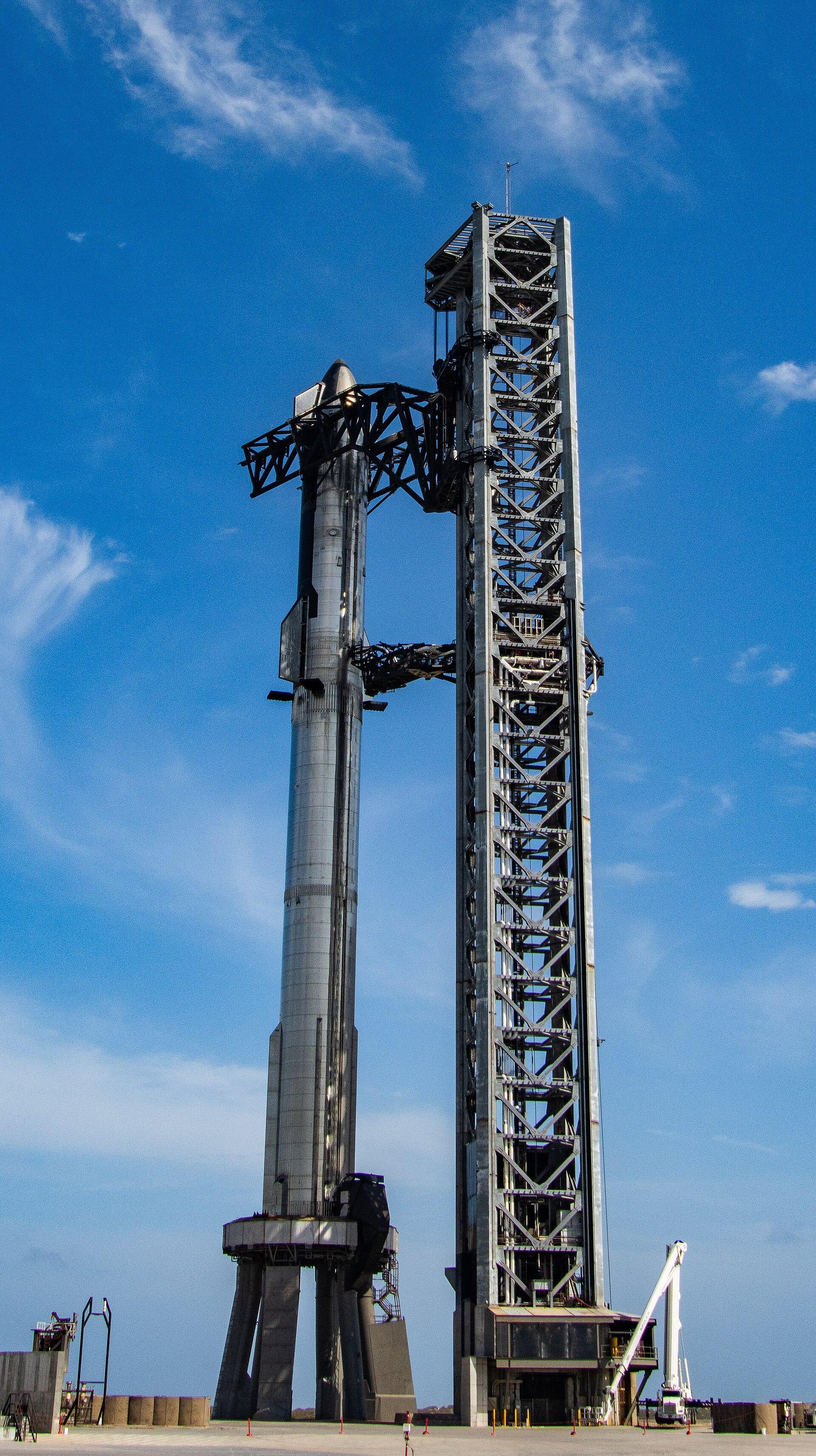
Stack Specifications
Total height
121.3 M
Diameter
9.0 M
Mass (wet)
~5,000 T
Thrust
74.4 MN
Components · 11
Tap to expand
— Boca Chica, Texas
SpaceX's dedicated Starship development and launch facility. The first purpose-built site for a fully reusable orbital launch system.
Pad Area
Starbase Area
Launch Azimuth
Distance to shore
Aerial — Live Site
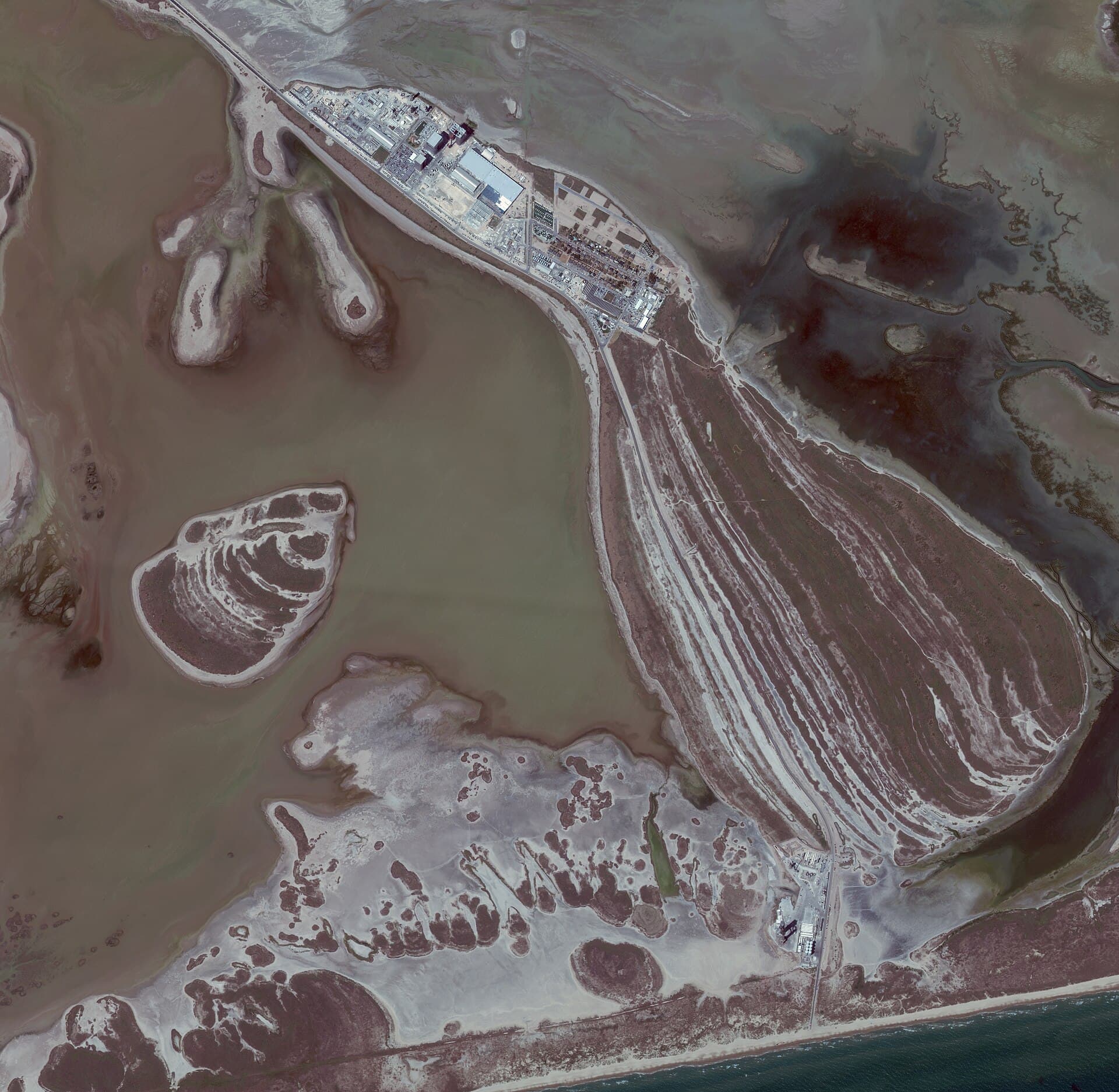
STARBASE · BOCA CHICA · TX
25°59'45″ N 97°09'25″ W
N ↑
FAA LSO
Facilities · 7
Tap to expand
Key Infrastructure
Orbital Launch Mount
Pad A
Mechazilla Arms
Chopstick span
Booster QD
Methane/LOX
Deluge System
Steel plate
High Bay
Integration
Ship/Booster
Current build
Site Milestones
Site cleared
Boca Chica Beach rezoned
SN15 landing
First successful hop + land
IFT-1
First orbital stack ignition
First booster catch
Mechazilla catches B12 · IFT-5, Oct 13
Booster reflight
B14 caught (IFT-7), reflown on IFT-9
First orbit
V3 reaches orbit, deploys 26 Starlink V3 · Flight 14, Sep 28
Coordinates
LATITUDE
25°59'45″ N
LONGITUDE
97°09'25″ W
DESIGNATION
Starbase, TX · FAA Launch Site Operator License
ICAO: MX12 · IATA: N/A
— Beyond Low Earth Orbit
Starship is not just a rocket. It is the infrastructure for a multi-planetary civilisation — from lunar landings to Martian colonies, orbital refueling depots to space-based compute.
Red Planet
Originally targeting the 2026 transfer window for uncrewed landings, in February 2026 Elon Musk announced a 5–7 year delay to focus SpaceX resources on lunar operations. First uncrewed Starships to Mars are now expected in the 2030/31 or 2032/33 transfer windows, with crewed missions to follow.
Artemis HLS
NASA selected Starship as the Human Landing System. After repeated HLS readiness delays, NASA confirmed in April 2026 that Artemis III (2027) will now be a LEO rendezvous test with both Starship HLS and Blue Origin's Blue Moon — no lunar landing. Artemis IV (2028+) is designated as the first crewed Moon landing of the program.
Earth to Earth
SpaceX envisions Starship for ultra-fast Earth travel — New York to London in 30 minutes, anywhere on Earth in under an hour. Flying at orbital velocity outside the atmosphere eliminates the friction of conventional flight.
Orbital Refueling
Deep space missions require more propellant than any single Starship can launch. SpaceX is developing an on-orbit propellant depot — a tanker Starship fills it, a mission Starship docks to top up for the journey to the Moon or Mars. With Starship reaching orbit for the first time on Flight 14 (Sep 2026), the first ship-to-ship transfer demonstration is targeted for no earlier than late 2026.
Starshield
Starshield is SpaceX's national security-focused derivative of Starlink and Starship. Designed for government and DoD use cases including intelligence gathering, communications, and classified space operations at scale.
Compute from Space
SpaceX and xAI are exploring Starship as a launch vehicle for orbital AI compute clusters — massive data centers in Low Earth Orbit powered by solar arrays, free from ground-based energy constraints and benefiting from passive radiative cooling in space.
Projected Roadmap
On June 12, 2026, SpaceX began trading on the Nasdaq as $SPCX — a $1.77 trillion debut and the largest IPO in history. We break down every number behind it: valuation math, Starlink revenue, ownership, dilution risk, and how to buy.
Ticker
$SPCX
Nasdaq Global Select
IPO Date
Jun 2026
Public since 06-12
Valuation
$1.77 T
6th-largest US stock
Raised
$75 B
Largest IPO ever
Live · TradingView · 15-min delayed where required
— Community
Bug entdeckt? Idee fürs Catch-Game? Daten falsch? Schreib es uns. Jeder Vorschlag wird gelesen, geprüft, und veröffentlicht — wenn er gut ist, baue ich ihn.
Recently published
gute app
Anonymous·Site
bitte eine neue mechanik
Dirk·Catch Game
Mehr Bilder wären Gut
Joaqueen·Site
Latest AI Insight
SpaceX successfully launched the Falcon 9 Block 5 rocket carrying Starlink Group 10-31 from Space Launch Complex 40 at Cape Canaveral Space Force Station on May 21, 2026, at 10:04 UTC. The mission deployed 29 Starlink v2-mini satellites into low-Earth orbit as part of the ongoing constellation expansion. The flight proceeded nominally through liftoff, stage separation, and second-stage burns, with the upper stage releasing the payload approximately 57 minutes after launch.
No anomalies or unexpected events were reported during the ascent or orbital insertion phases. The first-stage booster B1077 completed its 28th flight and executed a successful downrange landing on the A Shortfall of Gravitas droneship in the Atlantic Ocean roughly eight minutes after liftoff. Payload deployment was confirmed via official timelines, with all satellites released into their intended orbits.